

Many companies in production and trade are struggling with the constantly rising cost factor of electricity costs. However, many of them are also missing out on a lot of potential savings because they are not fully exploiting the possibilities of intelligent self-consumption optimization with peak shaving. Find out here how you can use peak shaving with electricity storage and solar power in industry and commerce to save costs, contribute to grid stability at times of high demand and become more self-sufficient - with energy solutions from 42technology.
Optimize your electricity consumption with peak shaving using battery storage
If your company is in the manufacturing industry, your electricity consumption probably peaks when your machines are running at full capacity. Unfortunately, this often leads to disproportionately high electricity costs, as your grid operator charges you very high grid usage fees for such peak loads. This means that it is not your average consumption but the peak load that becomes the decisive cost factor, however short-lived it may be. So what can you do about it?
You can throttle the respective machine and thus reduce the power consumption. In many cases, this is of course not an ideal solution, as it would lead to production downtime, which is rarely better than a higher electricity bill. The alternative is to switch to an alternative power source, such as an in-house outdoor power storage system, at times when your power demand rises sharply and a peak load occurs, to compensate for this short-term fluctuation. This second option is known as peak shaving and is one of the functions of intelligent load management.
What is Peak Shaving?
Peak shaving has advantages for you as a consumer, your energy supplier, and the grid operator: while you benefit from significant savings potential, the supplier has to take fewer load fluctuations into account. This article explains exactly how peak shaving works:

In the late morning, electricity consumption rises sharply. With the help of intelligent peak shaving, it is now possible to cap the power drawn from the grid at a certain level by providing the additional power during this period from an in-house battery storage system (peak shaving with battery storage). This setup allows you to maximize efficiency when drawing power from the grid because peak loads are completely buffered by the battery and no longer drive up your grid usage fees. The battery storage system is then recharged during a phase of low electricity demand. A photovoltaic system is worthwhile here for the cost-effective generation of your own solar power. This allows the electricity in the battery storage system to be recharged and saves balancing energy the power grid. At times of low demand, solar power can be charged for your own consumption. However, if there is a surplus, it is also possible to feed energy into the power grid. Without a photovoltaic system or other power source, energy from the grid can be used to charge the battery storage units, thus ensuring constant consumption without major fluctuations through load management.
With this setup, you can cap peak loads with battery storage and save a lot on grid fees. Whether this is worthwhile for your company depends heavily on the consumption profile of your system. To access this information, you need to know your consumption rate and annual consumption—information that you can typically obtain from your electricity provider.
The difference between peak shaving and load shifting
The difference between peak shaving and load shifting lies in the strategy used to optimize energy consumption. While peak shaving aims to cap peak loads in electricity consumption in real time in order to avoid the highest cost-incurring energy purchases, load shifting focuses on shifting energy consumption from peak times to periods of lower demand . This means that with load shifting, customers strategically plan their energy consumption so that less energy is used during expensive peak hours, often through the use of storage systems or flexible production schedules. Both approaches help to reduce energy costs and promote grid stability, but they use different methods to achieve the same overall goals.
Optimize self-consumption and save on usage fees
Without peak shaving, the usage fee depends heavily on the maximum average power that the energy supply company makes available to you.
- Power calculation (kW): Power is measured in kilowatts (kW) and corresponds to the amount of energy required by the company at a given time. This is often calculated as an average over a certain period of time. In the event of peak loads, the energy supplier precisely identifies the users responsible. It records the maximum average power consumption at 15-minute intervals. The highest measured average power value is selected as the basis for the power price.
- Annual energy (kWh): The annual energy is calculated from the measured output and the duration of energy consumption. It is measured in kilowatt hours (kWh) and represents the total energy consumed over a period of time.
- Grid usage: The grid usage charges are set by the energy supply company and are based on the maximum output (kW) and annual energy (kWh). There may be different tariffs for different times of day and days of the week.
Calculation example for peak shaving: If a company uses an average power of 65 kW for all devices and machines, but at a certain point in time production increases by 60 kW—even if only for a brief moment—then this peak load of 125 kW is used to calculate grid usage. Prices vary depending on the tariff and grid operator. Assuming a power price of CHF 15 per kW, the additional 60 kW will add CHF 13,930 to the monthly electricity bill for this operation. Electricity consumption costs are added to this.
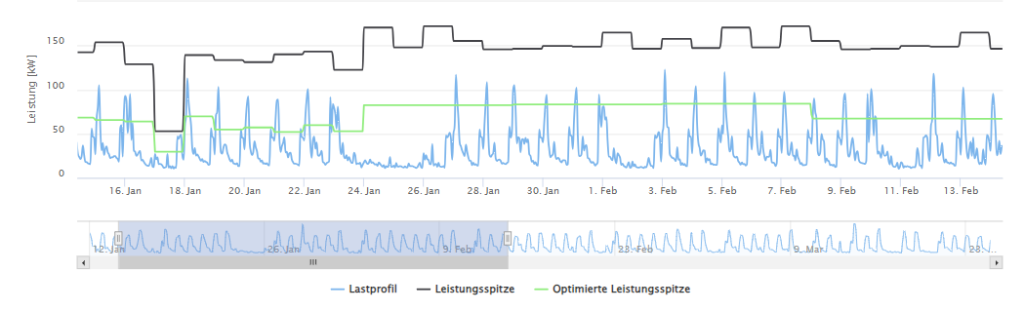
Diagram: Load data of a small bakery business with short load peaks (10 employees). In this situation, a battery system is amortized in 6-7 years* (*depending on the tariff structure).
Peak shaving: how the peak saving strategy pays off
Once the battery storage system with intelligent peak load capping has been installed, you don't have to worry about anything else. The automatic system recognizes when consumption threatens to exceed the threshold you have defined and automatically switches on the battery storage system. Automated peak shaving can influence the calculation of usage charges:
- Peak shaving calculation (kW): Peak shaving is used to optimally reduce the peak load, often through the use of energy storage systems or load management. To do this, the maximum output during the peak load is calculated and subtracted from the total output.
- Modified output (kW): The modified output is the adjusted output after applying the peak shaving strategy. This is used to calculate the usage fees.
- Grid usage fee for modified output: The grid usage fee is now calculated on the basis of modified output and annual energy. The modified output can lead to lower charges if companies reduce their peak loads.
How is the savings potential of 42technology determined?
The potential savings in electricity consumption are calculated by means of a detailed analysis of your individual energy consumption profile (load profile) and local tariff structures. With the help of our analysis tools, we can determine the precise potential savings. To do this, the load profile, i.e., the meter data from the energy consumption measurement, is analyzed over a period of preferably 1 to 3 years. Various battery systems with different power capacities are compared with your load profile. Precise simulations are used to determine which of the systems offers the greatest savings potential.
To perform this analysis, meter data at 15-minute intervals is required. This can be requested from your energy supplier. The local tariffs relevant for the analysis can be found on your electricity bill. In addition, e-mobility can contribute to optimizing self-consumption by charging electric vehicles preferably when there is high self-generated electricity production, for example, from a photovoltaic system. This means that electricity from your own production is used directly on site and consumption from the public grid is minimized.
We can help you with intelligent load management
We are characterized by quality and reliability, which makes us your reliable partner in the search for industrial battery storage systems in Switzerland. Our extensive experience ranges from indoor battery storage systems for industry & commerce and outdoor power storage systems for large-scale industrial applications to various fields of application such as balancing energy, energy trading, emergency power systems, self-sufficient power grids and innovative approaches to alternative energy storage. We are also happy to support you in optimizing your self-consumption or implementing private energy storage systems for your home.
Contact us today and equip yourself for the future of energy supply!
Frequently Asked Questions
What is peak load reduction?
Peak load reduction involves reducing peak loads in a company's electricity consumption at certain times in order to make optimum use of all potential. This can be achieved through various strategies such as peak shaving, demand side management, and load shifting. Peak shaving involves shifting energy consumption to times of low overall demand in order to avoid peak loads. Technologies such as battery storage and combined heat and power plants are used to store excess energy and release it when needed. By reducing peak loads, companies can lower their electricity costs and make a sustainable contribution to energy management.
What are the advantages of peak shaving (at a glance)?
Peak shaving offers a wide range of benefits, enabling companies to significantly reduce both their costs and their environmental footprint. One of the most important advantages is the immediate savings in grid usage fees, as reducing peak loads lowers the calculated peak load. In addition, peak shaving helps to relieve the strain on the power grid by reducing the load during peak times, which in turn leads to greater grid stability. Companies also benefit from greater independence from external energy prices, as the integration of battery storage systems promotes the use of self-generated energy. This not only improves economic efficiency, but also supports a sustainable energy supply by increasing the use of renewable energies. Ultimately, peak shaving also brings a strategic competitive advantage, as it enables companies to respond better to fluctuating market conditions and optimize their operating costs.
How can companies benefit from reducing peak loads?
Reducing the peak load offers companies various advantages. By avoiding peak loads, companies can reduce their electricity costs as they avoid the expensive demand charge. In addition, peak load reduction relieves the energy system and helps to stabilize the power grid. Companies that rely on peak load reduction can optimize their energy consumption and make a contribution to sustainable energy management.
How can companies effectively implement strategies to reduce peak loads?
In order to effectively implement strategies to reduce peak loads, companies can consider various approaches. One method is to optimize energy consumption during peak times by scheduling non-essential tasks for off-peak times. Introducing demand response programs can also help by creating incentives for customers to reduce their electricity consumption during peak times. Investing in energy storage solutions can provide a buffer during times of high demand, allowing businesses to draw on stored energy rather than relying solely on the grid. In addition, by using smart grid technologies and predictive analytics, companies can better predict and manage peak loads more efficiently. By combining these strategies and using innovative technologies, companies can successfully reduce peak loads and improve their overall energy management.
How does peak load reduction contribute to grid stability and reliability?
Peak load reduction makes a significant contribution to grid stability and reliability by reducing the load on the electricity grid during peak times. This innovative approach helps to avoid bottlenecks and improve the overall efficiency of grid operation. Through targeted measures such as load shifting and demand response programs, grid operators can reduce peak loads and thus achieve a more even distribution of energy generation and use. This not only increases grid stability, but also ensures the reliability of the electricity supply for end consumers.
When do load peaks occur in an industrial company?
Peak loads in companies are caused by a combination of different factors that often come together in unexpected ways. These peaks can be caused by daily work in production, shifts in production schedules, seasonal fluctuations in demand, changes in consumer behavior or even external events such as promotions that have an impact on production levels. It is important for companies to be flexible and have effective strategies in place to manage peak loads. By using battery storage and adaptive energy management (AI), companies can better respond to peak loads and successfully optimize their business.
What is an energy management system (EMS)?
An energy management system (EMS) is a tool for monitoring, controlling and optimizing energy consumption in companies or organizations. It enables efficient management of energy sources and consumption in order to cut costs and reduce environmental impact. By implementing an EMS, companies can analyze their energy consumption, identify trends and take targeted measures to improve energy efficiency. A well-designed EMS can help reduce the environmental footprint while increasing the company's competitiveness.
Use of AI for energy optimization
The use of artificial intelligence (AI) offers companies the opportunity to optimize their energy consumption efficiently. AI algorithms can analyse large amounts of data and identify patterns in order to optimize energy consumption and reduce peak loads. By using AI, companies can reduce their electricity costs and make a sustainable contribution to energy management.
Why are there peak loads in your company?
Peak loads in industrial companies are caused by simultaneous high energy requirements, e.g. when starting machines. These peaks put a strain on the electricity grid and cause costs. Peak load reduction strategies are critical to increasing efficiency and reducing operating costs. Understand how they occur and how peak shaving strategies can minimize them.
Starting production lines or machines, powerful motors, welding robots, appliances such as ventilation and air conditioning systems or oven systems (baking oven, curing oven) cause peaks. By reducing peak loads, companies can reduce costs and improve grid stability.
What is the GENIA EMS?
The GENIA EMS is an innovative energy management system that intelligently reduces peak loads. By efficiently controlling consumers and storage units, it optimizes energy consumption and thus enables cost savings and a sustainable energy supply.
Can I delay the expansion of a transformer station with an EMS?
The introduction of an energy management system (EMS) can postpone plans to expand a substation. This technology optimizes energy use, reduces peak loads, and may delay infrastructure upgrades. Learn how EMS contributes to efficient energy distribution.
What role do renewable energies play in peak shaving?
Renewable energies play a crucial role in peak shaving, as they can help to smooth out peak loads in energy consumption. By integrating renewable energy sources such as solar and wind power into the electricity grid, surplus energy can be stored during periods of low demand and then called upon during peak times. This enables more efficient use of available energy resources and helps to stabilize the grid. In addition, the increased use of renewable energy promotes the transition to a more sustainable energy supply and reduces dependence on fossil fuels, which can have a positive impact on the environment and climate change in the long term.
What are the first steps in implementing peak shaving?
Peak shaving is an effective method for reducing energy costs and improving energy efficiency in industrial plants. The first steps in implementing peak shaving begin with a thorough analysis of the company's energy consumption and peak loads. This identifies potential savings and creates a customized plan to smooth out peak loads. This can be achieved through the use of energy storage systems, load shifting strategies or the optimization of production processes. Once the plan has been implemented, it is important to continuously monitor and adjust the process to achieve optimal results and ensure long-term savings.
What is demand side management (DSM)?
Demand side management (DSM) is an umbrella term that encompasses all measures by which consumers adapt their electricity consumption to the situation of the electricity system—either by shifting, reducing, or increasing consumption. DSM also includes peak shaving and load shifting, but is more comprehensive.