

Smart Grid and Smart Market: How smart grids are changing the energy market in Switzerland
The energy supply in Switzerland is undergoing structural change. Decentralized electricity production, the expansion of renewable energies, and increasing demands on security of supply are posing new challenges for traditional electricity grids. At the same time, there is a growing need for transparency, flexibility, and controllability in grid operation.
Smart grids and the resulting smart market form the technological and economic basis for overcoming these challenges. A smart grid digitally links generation, consumption, storage, and grid infrastructure. The smart market describes the market that is built on these intelligent grids and enables new roles, processes, and business models. Together, these two systems represent the future of the Swiss energy market.
What is a smart grid?
A smart grid is an intelligent power grid that uses digital technologies to efficiently connect the generation, distribution, and use of electricity. It focuses on real-time data, automated control, and the active involvement of all grid participants.
Smart grids enable continuous communication between plants, consumers, grid operators, and energy markets. This makes it easier to balance fluctuations in electricity production, for example from photovoltaics or wind, and keep grid operation stable. Smart grid technology thus forms the basis for stable and efficient grid operation, especially with high penetration of renewable energies.
What makes an electricity grid smart?
A smart grid differs fundamentally from conventional grids in its ability to collect and analyze data and automatically derive control decisions from it. Sensors, smart meters, and digital communication systems provide real-time information on electricity consumption, feed-in, and grid status. This data makes it possible to actively control energy flows, reduce peak loads, and efficiently integrate renewable energies. Consumers are transformed from passive recipients to active participants in the system.
Key components and smart grid technologies
Smart grids are based on the interaction of several technical components:
| Komponent | Function in the smart grid |
| smart meter | Real-time recording of consumption and feed-in |
| sensory analysis | Monitoring of network parameters such as voltage and frequency |
| automation | Load control and grid regulation without manual intervention |
| communication systems | Data exchange between grid, plants, and market |
| IT security | Protection of sensitive consumption and operating data |
Smart grids as the key to Switzerland's energy transition

Smart grids are not an option for Switzerland's energy transition, but a prerequisite. The expansion of renewable energies is increasingly shifting electricity production to distribution grids. Photovoltaic systems on roofs, smaller hydroelectric power plants, storage facilities, and, in the future, electric mobility are changing the flow direction in the grid. Electricity is no longer produced and distributed centrally, but generated, stored, and consumed decentrally.
This development poses a structural challenge for existing power grids. Without intelligent control, local overloads, voltage fluctuations, and a growing need for grid expansion will occur.
This is exactly where smart grids come in. They create transparency regarding the status and utilization of the grids and enable grid operators to coordinate generation, consumption, and storage.
This approach is particularly relevant for Switzerland, as grid expansion is time-consuming, expensive, and socially sensitive. Smart grids allow existing infrastructure to be better utilized and investments to be planned in a more targeted manner. This makes them a key instrument for combining security of supply, climate targets, and economic efficiency.
The role of storage in the integration of renewable energies
The integration of renewable energies is one of the most challenging tasks in the smart grid. Photovoltaics and wind do not supply electricity according to demand, but rather depending on the weather. At the same time, electricity consumption increases during certain time windows, for example due to heat pumps or electromobility.
Smart grids make it possible to better manage this temporal and spatial decoupling. Real-time data from the grid allows feed-in and consumption to be coordinated. Storage facilities play a key role in this process. They buffer surpluses, provide short-term power, and relieve the burden on grids in critical situations.
This interaction is particularly relevant in distribution networks with a high density of photovoltaic systems. Electricity storage systems and smart grids make it possible to continuously coordinate feed-in and grid load. Surpluses can be temporarily stored, peak loads can be specifically cushioned, and critical situations can be identified early on. This applies to both private users of electricity storage systems and battery storage systems in industry and commerce. This enables grid operators to make better use of existing infrastructure and plan necessary expansions more precisely without slowing down the integration of renewable energies.
Demand-based control and PV curtailment as a system solution
A concrete example of this system logic is the demand-driven curtailment of photovoltaic systems (PV curtailment). High solar production is increasingly leading to local grid bottlenecks, especially in rural regions of Switzerland. Without control options, grid operators often have no choice but to expand the grid at great expense.
Smart grids open up a different path. Via digital communication interfaces, systems receive signal specifications from the grid operator in order to adjust their feed-in power to the situation. This control takes place in real time and is based on current grid data. Technically, the approach is similar to classic ripple control technology, but IoT solutions make it significantly more precise and flexible.
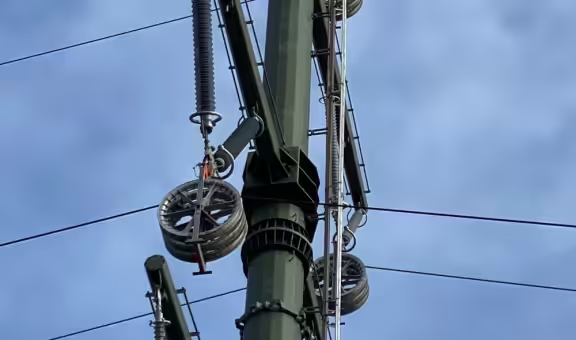
The main advantage lies in the system effect. Targeted, temporary curtailments enable grid operators to respond to local bottlenecks and ensure grid stability. This makes it easier to plan investments in new infrastructure and align them with actual demand. Renewable energies remain fully integrated and can be reliably incorporated into grid operations in the long term. This benefits grid operators, plant operators, and consumers alike.
From smart grid to smart market: When networks and markets converge
As power grids become increasingly intelligent, the energy market itself is also changing. The smart market describes this transition from a static electricity market to a dynamic system that responds to real-time information. In the smart market, prices, loads, and flexibilities are more closely aligned with the current state of the grids. Consumption, generation, and storage can be better coordinated in terms of time and space. This makes flexibility a useful feature of the system. Consumers, storage facilities, and producers can provide targeted services that alleviate grid bottlenecks and smooth out peak loads. Smart grids create the technical basis for this, while smart markets translate these opportunities into market-based incentives.
This approach opens up new perspectives for Switzerland. Instead of flat-rate network charges and fixed tariffs, more differentiated models are emerging that reward network-friendly behavior. The energy market is thus evolving in line with real network requirements. New roles, clear rules, and digital platforms ensure transparency and reliability. At the same time, security of supply is maintained while efficiency potentials are systematically exploited.
The active role of consumers in the smart electricity system
In the smart grid, consumers lose their passive role. Households and businesses become active players in the intelligent electricity system. Smart meters create transparency regarding consumption, feed-in, and time patterns. This information forms the basis for informed decisions.
The principle of "flexibility" is becoming increasingly important in the smart market. Flexibility refers to the ability of plants or consumers to adapt their behavior when the state of the grid changes. This can happen in various ways, such as:
- Shift consumption: A household does not charge its electric car immediately, but rather when the grid is under low load or when there is a lot of solar power available.
- Adjusting output: A heat pump reduces its output in the short term without compromising comfort.
- Using storage: Battery storage systems absorb electricity when there is a lot of energy in the grid and release it when demand increases.
- Controlling generation: Photovoltaic systems or combined heat and power plants adjust their feed-in to the grid situation.
In smart markets, differentiated tariff models create incentives for consumers to respond flexibly. This applies not only to households, but also to commerce and industry, whose loads offer considerable potential for flexibility. The smart market offers a win-win situation: consumers benefit from transparency and potential savings, grid operators from more stable grids, and the overall system from greater efficiency.
Challenges between technology, regulation, and acceptance
The introduction of smart grids and smart markets brings with it a variety of challenges that are closely interlinked:
- Technical integration and operation: Smart grids connect numerous systems, devices, and platforms. Clear standards, compatible interfaces, and a stable IT infrastructure are needed to ensure that they work together reliably. At the same time, IT security requirements are increasing as grid operation is increasingly controlled digitally.
- Regulatory framework and market logic: In Switzerland, new market mechanisms must be designed in such a way that they enable innovation while ensuring network stability. Flexible tariffs and new roles in the smart market require clear rules so that incentives can take effect without burdening network operations.
- Data protection and social acceptance: Smart meters collect detailed consumption data, which is why data protection and data security are crucial. Consumer trust is needed to exploit this potential. This trust can only be established if clear rules and responsibilities apply and technical security is guaranteed to protect all relevant data.
These points show that the success of smart grids depends largely on how technology, the market, and regulation are developed and coordinated together.

Outlook: Smart grids as strategic infrastructure
Smart grids and smart markets are increasingly becoming the strategic infrastructure of energy supply. They connect renewable energies, storage facilities, consumers, and markets to form a flexible overall system. For Switzerland, this means greater resilience to supply fluctuations and more efficient use of existing grids.
The next step in development lies less in individual technologies than in system integration. Electric mobility, storage, demand response, and digital marketplaces are converging. Smart grids are the connecting element in this process.
In the long term, the ability to intelligently control, distribute, and market energy will determine the success of the energy transition. Smart grids and the resulting smart market create the necessary conditions for this.